
What Is Inositol? Benefits, Types, Uses & Safety
Inositol is increasingly discussed for PCOS, insulin resistance, blood sugar, fertility, and other wellness goals. The body produces it naturally,


Reverse osmosis (RO) filtration changes the mineral composition of drinking water, which often raises questions about what happens after filtration. Some people prefer the taste of remineralised water, while others want to understand which minerals their system has reduced. Before choosing trace mineral drops, it helps to know how RO treatment works, what different formulas contain, and whether adding minerals fits your everyday drinking water needs.
An RO system uses pressure to move water through a semipermeable membrane. The membrane reduces many dissolved substances while treated water passes through to the next stage. Because minerals are dissolved substances, some can be reduced during RO treatment.
Depending on the system and source water, RO can reduce or remove substances such as sodium, chloride, sulfate, calcium, magnesium, and potassium. The exact result varies, so check your system specifications rather than assuming every RO unit removes the same amount of every mineral.
Different forms of magnesium supplements can be absorbed differently by the body. Forms that dissolve more easily are generally absorbed better than those that dissolve less easily. However, this does not mean that every liquid mineral supplement is better absorbed than every capsule. The type of magnesium used in a supplement is one factor that can affect absorption.
The final mineral content depends on the membrane, system design, source-water composition, pressure, and maintenance. Two different RO systems can therefore produce different mineral profiles. Saying that “RO removes all minerals” is too broad.
Not necessarily. Drinking water is one source of minerals, while food is generally a major source of daily mineral intake. Some people choose to remineralise because they prefer the taste, want to change the mineral content, or want selected minerals in their drinking water.
Low mineral content alone does not establish that water is unhealthy. A TDS reading also cannot tell you exactly which minerals are present. The decision should be based on the actual water, intended use, and personal preference rather than a single number.
You may consider adding minerals after RO if:
If you are satisfied with your RO water and your overall diet provides adequate mineral intake, you may have no reason to add a mineral product. Remineralisation is not a universal requirement for everyone using reverse osmosis.
Trace mineral drops are concentrated liquid formulas designed to add selected minerals to water. They can be used after RO filtration when the product directions are intended for that use.
Not all minerals reduced by reverse osmosis (RO) filtration are classified as trace minerals. Calcium, magnesium, sodium, potassium, and chloride are generally considered major minerals, while zinc, selenium, copper, iodine, manganese, and chromium are needed in smaller amounts. What Are Trace Minerals? explains the differences between major and trace minerals and their roles in normal body functions.
This matters because trace mineral drops do not automatically replace every mineral that an RO system may reduce. A formula should be judged by its actual mineral profile, not simply by the word “trace” on the label.
Two products can both be called mineral drops while having different formulas. Compare:
Check the label rather than assuming all mineral drops for RO water work in the same way.
Drops require no installation and can be added to a glass, bottle, or pitcher after filtration according to the product directions. They are practical when you want control over when and how much of a formula you add.
A remineralisation cartridge is installed as part of the water-treatment setup, commonly after the RO membrane. It adds minerals as water passes through the media. The mineral profile depends on the cartridge and system, and cartridges require replacement.
Drops offer flexibility, while a cartridge provides a more integrated household setup. Neither approach is automatically better.
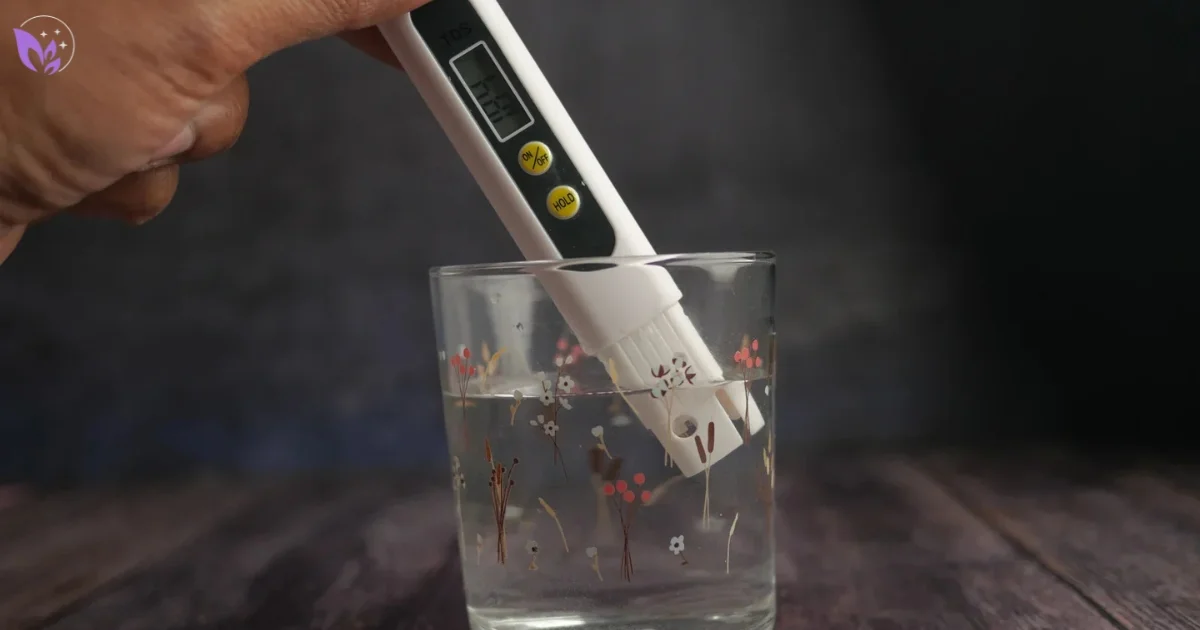
TDS stands for total dissolved solids. It provides an overall measure of dissolved material in water, including substances such as calcium, magnesium, potassium, sodium, bicarbonates, chlorides, and sulfates.
A TDS meter measures the overall amount of dissolved substances in water, but it cannot identify individual minerals or their concentrations. A higher reading does not automatically indicate better water quality, just as a lower reading does not necessarily mean the water is unsafe.
The World Health Organisation’s fact sheet on total dissolved solids provides further information on what TDS measures and how it relates to drinking water quality.
Look at the exact minerals included and the amount provided per serving. Check whether the formula contains major minerals, trace minerals, or both. A longer ingredient list is not automatically a better formula.
Compare the serving size, concentration, and recommended use. Never copy a drop count from another product because formulas can differ. Use the serving instructions provided for the specific product.
If possible, understand your source water and the performance of your RO system before deciding what to add back. A water-quality report, product specifications, or appropriate testing can provide more useful information than guessing from taste or TDS alone.
When evaluating wellness supplements, check for clearly listed ingredients, transparent serving sizes, appropriate storage instructions, and relevant safety information. How to Choose the Right Wellness Supplements covers key factors to consider when comparing supplement products.
TRACE Essential Minerals from Mahoney Inter is a liquid mineral formula designed to be mixed with water or another drink. Its listed serving is 1 mL, and its mineral profile includes magnesium, chloride, sodium, potassium, sulfate, lithium, and boron. Because the formula contains a specific set of minerals rather than every mineral an RO system may reduce, it is better understood as a way to add selected minerals after filtration rather than as a complete replacement for everything removed.
Not automatically. The choice depends on your water, mineral profile, taste preference, and intended use.
Yes, provided the treated water is otherwise safe to drink. Low mineral content alone does not determine whether drinking water is safe.
RO can reduce several dissolved substances, including sodium, chloride, sulfate, calcium, magnesium, and potassium, but exact reduction depends on the system and source water.
There is no single formula for everyone. Choose based on the mineral profile you want and your treated water.
Yes, when the product directions specify use with water. Follow the stated serving rather than copying instructions from another formula.
Generally, yes. Adding dissolved minerals increases dissolved material in the water, so the TDS reading can rise.
Not by itself. TDS is an overall measure of dissolved material and does not identify individual minerals or establish overall water quality.
Disclaimer: This article provides general information only and is not a substitute for medical advice. Consult a healthcare professional before using dietary supplements.


Noor-ul-Ain is a Tech & SEO Content Writer with over 4 years of experience creating search-optimized content for digital platforms. She specializes in SaaS products, AI tools, SEO strategy, and product documentation, helping platforms turn complex features into clear, search-driven growth. Noor-ul-Ain has also written extensively on health science, sports, fitness, fashion, and beauty, focusing on informative and reader-friendly content.
Inositol is increasingly discussed for PCOS, insulin resistance, blood sugar, fertility, and other wellness goals. The body produces it naturally,

When choosing a liver support supplement, the ingredient panel often tells you more than the front label. Understanding why each

Collagen is one of the body’s main structural proteins, which is why collagen supplements have become popular for skin, joints,