Can You Take Zinc and Iron Together? Absorption, Timing & Safety
Yes, you can take zinc and iron on the same day. Some multivitamins even contain both. Higher amounts of supplemental

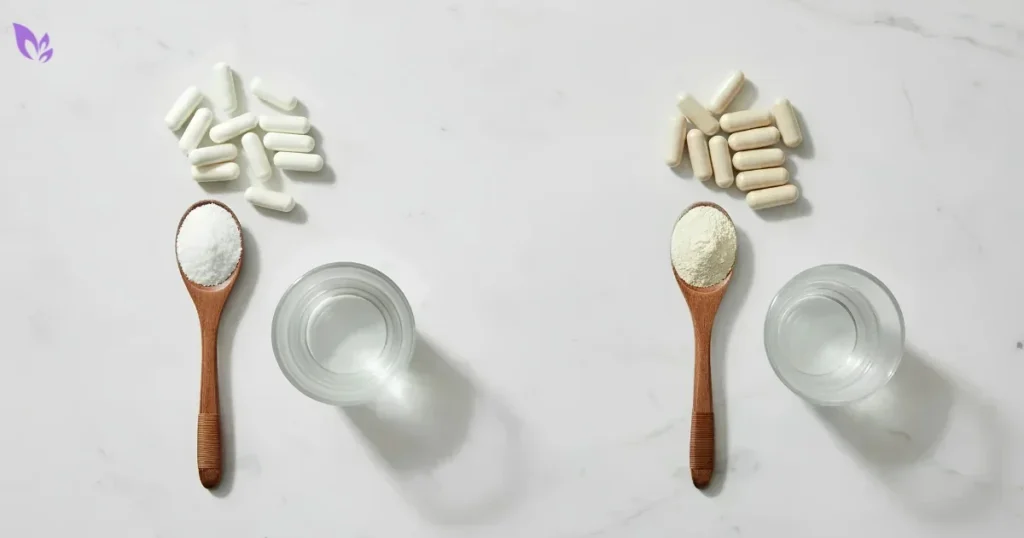
GlyNAC combines glycine and N-acetylcysteine (NAC), while NAC supplements contain N-acetylcysteine without added glycine. Both ingredients contribute to glutathione production, an important process that protects cells from oxidative stress.
The main difference between GlyNAC and NAC is the addition of glycine. Some clinical trials have found benefits from combining these ingredients, particularly in older adults. However, research has not established that GlyNAC is more effective than NAC alone.
The distinction matters when comparing their potential benefits, supplement doses, and safety.
NAC is a compound derived from the amino acid cysteine. The body can use it as a source of cysteine, one of the components needed to produce glutathione.
GlyNAC includes both NAC and glycine. Instead of supplying only a cysteine precursor, it provides two ingredients involved in glutathione synthesis.
| Feature | NAC | GlyNAC |
| Composition | N-acetylcysteine | Glycine and NAC |
| Glutathione support | Provides a source of cysteine | Provides glycine and a source of cysteine |
| Main research areas | Glutathione pathways and various medical applications | Glutathione status and age-related changes |
| Ingredients | One active compound | Two compounds |
| Proven superior? | No direct superiority established | No direct superiority established |
GlyNAC is not simply a stronger version of NAC. The ingredients have related biological roles, but adding glycine does not necessarily improve supplementation outcomes.
The reason for combining glycine with NAC comes from how the body makes glutathione.
Glutathione is produced using three amino acids:
The body needs all three to complete the process. Their availability can influence glutathione production, although other metabolic factors are also involved.
NAC provides a source of cysteine, which is involved in glutathione synthesis.
Glutathione helps maintain normal antioxidant defenses by participating in reactions that protect cells from oxidative damage. It is particularly important in the liver, where numerous metabolic processes take place.
NAC is also used as a medication for specific medical conditions, including acetaminophen overdose. Those established medical uses should not be confused with claims about over-the-counter NAC supplements.
Glycine is another component of glutathione. The body produces it naturally, and it is also obtained from protein-rich foods.
Researchers have investigated whether providing additional glycine alongside NAC helps when the availability of these amino acids limits glutathione production.
This is the main reason GlyNAC is being studied.
However, people do not necessarily need extra glycine simply because they take NAC. Nutritional status, age, health conditions, and other biological factors may influence the response.
Not necessarily.
GlyNAC supplies two components of glutathione synthesis, but this does not prove that it increases glutathione levels more effectively than NAC alone.
Most clinical studies have compared GlyNAC with a placebo rather than with NAC alone. As a result, they cannot determine how much of the benefit specifically comes from adding glycine.
Human research has produced mixed findings. Two randomized trials are particularly useful because they examined glutathione-related outcomes in older adults.
A randomized trial included 24 older adults. Twelve received GlyNAC, while the remaining twelve received a placebo for 16 weeks.
The researchers also studied 12 younger adults who received GlyNAC for two weeks.
Among the older participants taking GlyNAC, the trial reported improvements in glutathione concentrations, oxidative stress markers, and certain physical function measurements.
Participants received daily doses of glycine at 100 mg per kilogram of body weight and the same amount of NAC.
For someone weighing 70 kg, that equals approximately 7 grams of each ingredient daily.
The 16-week randomized clinical trial provides the full findings.
Although the results were promising, the trial was small. It also did not include an NAC-only group, so it cannot establish that combining glycine with NAC produces better results than taking NAC alone.
Another randomized trial examined GlyNAC supplementation in 114 healthy older adults over two weeks.
Participants received placebo or GlyNAC at total daily doses of 2.4, 4.8, or 7.2 grams.
Unlike the longer study, this trial did not find a statistically significant overall improvement in its primary glutathione measurements compared with placebo.
A later subgroup analysis suggested potential improvements among participants who had higher oxidative stress and lower glutathione levels at baseline.
That finding was exploratory and does not establish that everyone with similar characteristics would benefit.
The two-week randomized clinical trial describes these results.
The different outcomes suggest that responses to GlyNAC may depend on the people studied, their initial glutathione status, the supplement dose, and treatment duration.
Neither trial directly established that GlyNAC is superior to NAC alone.
The studies also did not demonstrate that GlyNAC prevents liver disease, reverses aging, or provides a general detoxification benefit.
The liver relies on glutathione as part of its normal antioxidant and metabolic processes.
Because NAC supplies a cysteine precursor, it is frequently included in supplements marketed for liver health. Glycine may also appear in these formulas because it contributes to glutathione synthesis.
However, supporting a normal biological pathway is different from demonstrating that a supplement improves liver function in people with liver disease.
The GlyNAC trials discussed above primarily focused on glutathione status and age-related outcomes. They did not establish the combination as a treatment for liver conditions.
Other compounds found in liver-support formulas work through different biological pathways. For example, NAC is associated with glutathione production, whereas TUDCA is a bile acid.
For a closer comparison, review NAC vs TUDCA for Liver Detox, which discusses their distinct roles.
There is no single clinically established GlyNAC supplement dose suitable for everyone.
The clinical trials used different amounts and study durations.
| Study | Daily GlyNAC dose | Duration |
| 16-week trial | 100 mg/kg each of glycine and NAC | 16 weeks |
| Two-week trial | 2.4, 4.8, or 7.2 g total GlyNAC | 2 weeks |
These were research doses, not general recommendations for supplementation.
Commercial NAC and GlyNAC products may provide substantially different quantities. Some contain both ingredients in equal amounts, while others use different ratios.
A supplement containing both NAC and glycine should not automatically be considered equivalent to the GlyNAC combinations tested in clinical trials.
For example, TNM Liver Support from Mahoney Inter lists 200 mg of NAC and 100 mg of glycine per two-capsule daily serving. It also contains other ingredients, including TUDCA, milk thistle, and minerals.
These quantities are much smaller than the amounts used in the clinical trials discussed above. The product is also a multi-ingredient formulation rather than the two-ingredient combination investigated in those studies.
For more details about the formula and its ingredients, see TNM Liver Support Ingredients Explained.
When comparing products, check the amount of each ingredient rather than relying on the supplement name alone.
GlyNAC was generally well tolerated during the clinical trials discussed above. However, short-term tolerability in a study does not establish long-term safety for every person.
Oral NAC can cause digestive side effects, including:
NAC can also interact with certain medications.
One important interaction involves nitroglycerin, a medication used for chest pain. Combining it with NAC may increase the risk of low blood pressure and severe headaches.
People taking blood pressure medications or blood thinners should also discuss NAC use with a healthcare professional.
Extra caution is appropriate during pregnancy or breastfeeding, when taking prescription medication, or when managing an existing medical condition.
Higher research doses should not be copied without medical supervision.
A supplement label can reveal more useful information than a product’s marketing claims.
Before comparing GlyNAC with NAC, consider these points:
Most importantly, do not assume that a larger dose or a longer ingredient list produces better results.
The main difference between GlyNAC and NAC is the addition of glycine. NAC supplies a cysteine precursor, while GlyNAC provides glycine alongside NAC for glutathione synthesis.
Some clinical studies have reported improvements with GlyNAC supplementation, but the findings are not consistent across trials. There is also insufficient direct comparative research to conclude that GlyNAC is more effective than NAC alone.
When comparing supplements, focus on their ingredients, studied doses, potential interactions, and the limits of the available clinical findings.
Current clinical research has not established that GlyNAC is better than NAC alone. GlyNAC contains glycine alongside NAC, but direct head-to-head trials are needed to determine whether the combination provides additional benefits.
Yes, glycine and NAC have been combined in human clinical trials. However, the amounts used in research should not be treated as recommended personal doses. Anyone taking medication or managing a medical condition should seek professional advice before combining supplements.
No. GlyNAC contains glycine and N-acetylcysteine, which provide two components the body uses to produce glutathione. It is not the same as taking a supplement containing glutathione itself.
Yes. NAC provides a source of cysteine, which the body uses to produce glutathione. Whether additional glycine improves that process depends on factors that are still being investigated.
GlyNAC is being investigated for its effects on glutathione and oxidative stress. However, current clinical findings do not establish it as a treatment for liver disease or prove that it improves liver health in the general population.
Disclaimer: This content is for general informational purposes only and does not replace professional medical advice, diagnosis, or treatment.


Noor-ul-Ain is a Tech & SEO Content Writer with over 4 years of experience creating search-optimized content for digital platforms. She specializes in SaaS products, AI tools, SEO strategy, and product documentation, helping platforms turn complex features into clear, search-driven growth. Noor-ul-Ain has also written extensively on health science, sports, fitness, fashion, and beauty, focusing on informative and reader-friendly content.
Yes, you can take zinc and iron on the same day. Some multivitamins even contain both. Higher amounts of supplemental
Yes, taking too much zinc can cause copper deficiency. High doses of zinc, especially when taken for several weeks, can
Liquid trace minerals are a good choice if you prefer mixing supplements into water or have difficulty swallowing capsules. Capsules